TL;DR
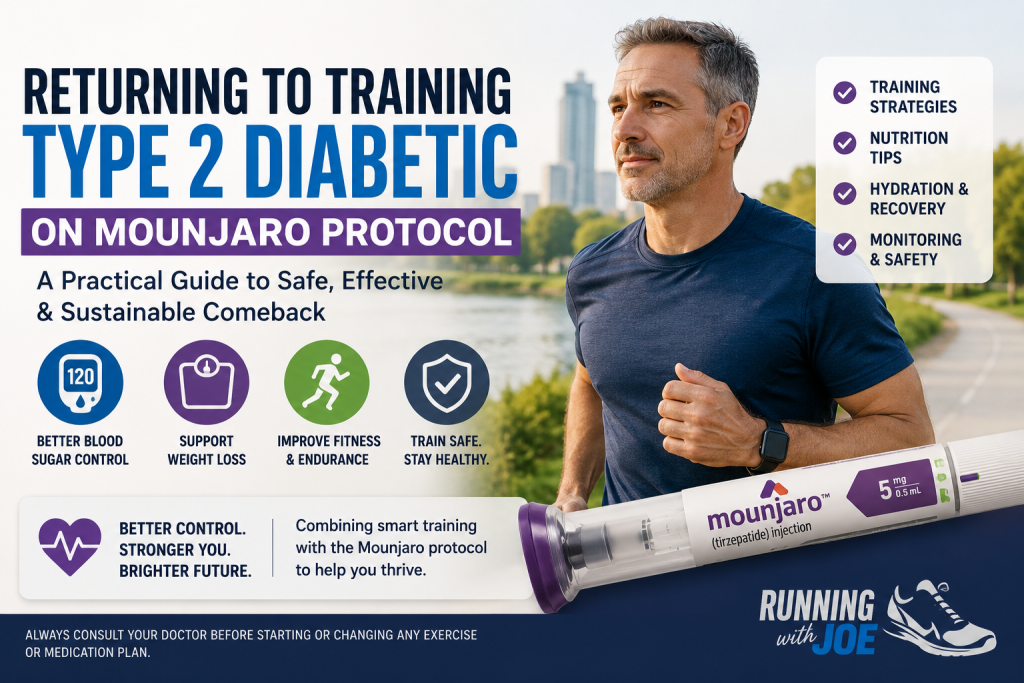
- Returning to training as a Type 2 diabetic on Mounjaro (tirzepatide) is not only possible — it’s one of the strongest combinations for metabolic recovery available today
- Mounjaro’s appetite suppression makes fueling for endurance work the hardest part — you need to actively eat enough, not just enough less
- Hypoglycemia risk drops vs sulfonylureas/insulin but doesn’t disappear — carry fast-acting glucose for any run > 45 min
- Most reasonable starting protocol: 3 days/week, Zone 2 only, 20-40 min sessions for the first 6 weeks. Then layer in 1 quality day
- Expect 5-15 kg of weight loss to dramatically improve running economy — but also expect strength to drop if you don’t add resistance training 2x/week
- Always coordinate with your endocrinologist before starting structured training, especially if you’re stacking Mounjaro with metformin, SGLT2, or insulin
If you’ve been diagnosed with Type 2 diabetes and your doctor put you on Mounjaro, you’re probably also looking at training again — either because you used to run and want to come back, or because your doctor said “you need to start moving.”
Good news: the combination of GLP-1/GIP agonists like tirzepatide + structured aerobic training is the most powerful intervention for metabolic syndrome we’ve ever had. Bad news: most generic running advice ignores the medication interaction, and most diabetic running advice was written before Mounjaro existed.
This is what actually works, based on what’s documented in clinical literature and what coaches who specialize in metabolic clients report. This is not medical advice — coordinate everything with your endocrinologist and sports medicine doctor before starting.
What Mounjaro actually does (in plain language)
Mounjaro is tirzepatide, a dual GLP-1 and GIP receptor agonist. Translated:
- Glucose-dependent insulin release — your pancreas releases more insulin when blood sugar is high, less when it’s low. This is why hypoglycemia risk is much lower than with sulfonylureas or basal insulin
- Glucagon suppression — your liver dumps less stored sugar into blood
- Delayed gastric emptying — food sits in your stomach longer, so blood sugar rises slower after meals
- Central appetite suppression — you feel full faster and stay full longer
- Weight loss — clinical trials show 15-22% body weight reduction at higher doses over 72 weeks
“Mounjaro fixes one problem (excess body weight and poor glucose control) by partially creating another for athletes: insufficient caloric intake to fuel training adaptations.”
The 5 things that change when you train on Mounjaro
1. You won’t feel hungry, even when you should be eating
This is the single biggest issue for returning runners. Mounjaro kills appetite signaling. After a long run you’d normally crush a meal — on Mounjaro, the idea of eating can feel mildly disgusting. You must eat anyway. Train your mind: hunger is no longer a reliable signal for energy needs.
Practical fix: pre-plan meals around training. Schedule fuel like medication. A simple template:
- 1 hour pre-run: 30-40g easy carbs (banana, oatmeal, rice cake with honey)
- Post-run within 60 min: 20-30g protein + 60-90g carbs (Greek yogurt + granola + fruit works)
- If session > 60 min: 30g carbs per hour mid-run (gel, sports drink, dates)
2. Stomach upset is real, especially after dose escalation
Common side effects week 1-4 of any new dose: nausea, fullness, sometimes vomiting. Running with this is miserable.
Practical fix:
- Don’t escalate dose the week before a key workout or race
- If you start a new dose, drop training volume 20-30% for 7-10 days
- Avoid high-fat pre-run meals (worse with delayed gastric emptying)
- Hydrate aggressively — Mounjaro can cause dehydration when combined with sweating
3. Weight loss improves running economy fast — but strength drops too
Every kilo lost = roughly 2-3 seconds per kilometer faster at the same effort. So if you drop 10kg, your easy pace naturally improves 20-30 seconds/km. This is a real and motivating effect.
The flip side: weight loss on Mounjaro includes lean mass loss if you don’t actively prevent it. Lose your quads and you lose your running economy gains. Resistance training 2x/week is non-negotiable:
- Squats, lunges, deadlift variations (bodyweight or weighted)
- 2-3 sets of 8-12 reps
- Schedule on non-running days or after easy run days
4. Hypoglycemia risk drops — but doesn’t disappear
Mounjaro alone doesn’t cause hypos. But stacked with metformin, sulfonylureas, SGLT2 inhibitors, or insulin (very common combinations), risk goes up during exercise.
Practical protocol:
- Test blood glucose before any run > 30 min. If < 100 mg/dL, eat 15-30g carbs first
- Carry fast-acting glucose for any session > 45 min (glucose tabs, gel, juice box)
- Test post-run if you feel “off” (sweaty, shaky, irritable)
- Consider a CGM (Dexcom G7, Libre 3) — game changer for endurance training as a diabetic
5. Recovery takes longer at first
Lower glycogen stores + lower caloric intake + medication side effects = slower recovery than your pre-diabetes self remembers. Plan for it.
- 1 hard session per 3-4 easy
- Sleep 7-9h prioritized (this is the highest-ROI recovery lever)
- Active recovery (walk, easy bike) better than full rest for most
A realistic 12-week return protocol
Modified from published return-to-exercise guidelines for Type 2 diabetics, adapted for GLP-1 medication.
| Weeks | Volume/week | Structure | Focus |
|---|---|---|---|
| 1-2 | 60-90 min | 3x walk/jog Z1-low Z2, 20-30 min | Get body moving, learn fueling routine |
| 3-4 | 90-120 min | 3x easy Z2, 30-40 min + 1x strength | Build aerobic base. No quality yet |
| 5-6 | 120-180 min | 4x easy Z2 + 1x strength + 1 longer (50-60 min) | Volume slowly up. Monitor BG patterns |
| 7-8 | 180-240 min | 4x easy + 1x light tempo (20 min) + 1 long (60-75 min) + strength | First quality work, very conservative |
| 9-10 | 240-300 min | 5x easy + 1 quality + 1 long (75-90 min) + strength | Build to consistent training week |
| 11-12 | 300+ min | 5-6 sessions varied + strength 2x | Maintain. Evaluate next 12-week block |
At end of week 12, reassess with endocrinologist:
- HbA1c trend (target < 6.5%)
- Weight trajectory
- Blood pressure
- Lipid panel
- Whether dose escalation or de-escalation makes sense
Gear that actually matters for diabetic runners
- Continuous Glucose Monitor (CGM) — Dexcom G7 or Libre 3. Real-time glucose during runs. Worth every dollar for safety + data
- HR strap (not wrist sensor) — Polar H10 or Garmin HRM-Pro. Wrist sensors lie in Zone 2 territory. You need accurate HR to stay in the right zone
- Hydration pack with pockets — carry glucose + ID + phone for any run > 45 min
- Medical alert bracelet — emergency responders need to know you’re diabetic + what medications you’re on
- Running shoes with extra cushion — diabetic feet are at risk of unnoticed injuries. Wide toe box + good cushion (HOKA, Brooks Glycerin, ASICS Nimbus)
What to discuss with your endocrinologist before you start
- Adjust other diabetes meds for training days (especially sulfonylureas, insulin)
- Target blood glucose range during exercise (typically 100-180 mg/dL)
- Whether to time Mounjaro dose differently around long sessions
- Annual foot exam + neuropathy screening before starting impact running
- Cardiac stress test if you’re > 40 or have other risk factors
- Eye exam — retinopathy can be aggravated by certain exercise types
Common questions
Will I lose weight from running on Mounjaro? Some additional weight loss, but most weight loss on Mounjaro comes from caloric restriction (because you’re not hungry). Running on Mounjaro is more about preserving lean mass and improving cardiovascular fitness than calorie burn.
Can I do a marathon while on Mounjaro? Documented cases exist. Requires meticulous fueling planning (against your reduced appetite) and CGM monitoring. Most coaches recommend waiting until weight stabilized and dose is established (typically 6+ months on therapy).
What if I want to come off Mounjaro after losing the weight? Coordinate with your doctor. Some people maintain remission of Type 2 diabetes through diet + exercise alone after weight loss. Others need to taper or maintain a maintenance dose. Stopping cold often results in appetite return + weight regain.
Will I be able to compete at the level I used to? Depends on starting point. Many returning runners report performance close to their pre-diabetes baseline within 12-18 months, especially when weight loss is significant.
The mindset shift
Returning to training as a diabetic on Mounjaro is not a “back to where I was” project. It’s a rebuild project. Your body chemistry is different. Your meds are different. Your appetite is different. Your weight is changing. Treat this as building a new athlete with the experience of the old one.
“The combination of Mounjaro + structured training isn’t just about getting back to running. It’s about putting Type 2 diabetes into long-term remission while building the strongest aerobic engine of your life.”
Medical disclaimer: This article is for informational and educational purposes only. It is not medical advice and is not a substitute for professional medical consultation. Always consult your endocrinologist and sports medicine physician before starting or modifying an exercise program, especially if you have diabetes, are on Mounjaro or any other GLP-1 medication, or have any other medical condition. Individual responses to medication and exercise vary significantly.
Related: how to start running while overweight.
Related: my real weight-loss comeback after a type 2 diabetes diagnosis — the personal side of this protocol.