Introduction: Why Slowing Down Might Be Your Secret Weapon
For years, the running world has been obsessed with the “no pain, no gain” mantra. We’ve been conditioned to believe that unless we are pushing the pace, gasping for air, and leaving a puddle of sweat on the track, we aren’t making any real progress. But what if I told you that the secret to unlocking your best performance actually requires you to hit the brakes?
If you’ve ever felt completely gassed out during what was supposed to be an easy run, yet paradoxically struggled to hit your goal paces during a workout, you’re stuck in a very common trap. The missing link isn’t another grueling speed session—it’s Zone 2 training for runners.
It feels completely counterintuitive at first. Running slow to get fast is a tough pill to swallow, especially when your Strava feed is full of people pushing the pace every single day. But the exercise science is clear: hammering every run is a one-way ticket to burnout, injury, and plateaued fitness.
The good news? You don’t have to choose between building massive endurance and maintaining your top-end speed. In this guide, I’m going to walk you through a practical, evidence-based approach to aerobic base building. We will cover exactly how to structure your training so you can run longer, recover faster, and build relentless endurance without losing an ounce of your hard-earned speed. Let’s dive into why slowing down might just be your ultimate secret weapon.

The Trap of the ‘Junk Mile’ (And How to Escape It)
Picture this: you head out for your daily run. You aren’t sprinting, but you aren’t exactly jogging, either. You’re breathing heavily, maybe listening to a podcast but missing a few words here and there. You finish your route feeling moderately tired, but not completely destroyed. You’ve just logged what coaches affectionately call “junk miles.”
Also known as the “gray zone,” junk miles happen when you run at a moderately hard effort for every single workout. It’s that tempting middle ground where you feel like you’re putting in the work, but you aren’t actually pushing your limits.
Here is the harsh reality: running in this gray zone day after day is one of the biggest limiters of your potential. Why? Because it applies enough stress to accumulate chronic fatigue, but not enough specific stress to trigger meaningful physiological adaptations. You aren’t running slow enough to build a massive aerobic base, and you aren’t running fast enough to improve your top-end speed or VO2 max. You’re just stuck in the middle—tired, stagnant, and wondering why your race times have hit a wall.
If this sounds familiar, take a deep breath. You are far from alone, and it is incredibly easy to fix. The secret isn’t about adding more grueling track intervals to your week; it’s about running with more purpose and better energy distribution. By embracing Zone 2 training for runners, you can systematically escape this trap. This science-backed approach ensures your easy days are truly easy, allowing your body to recover, build mitochondria, and improve endurance without the heavy, lingering fatigue. There is a better, proven way to train, and it starts with stepping out of the gray.
What Exactly is Zone 2 Training? The Science of the Slow Run
Let’s strip away the complex sports science jargon for a moment. If you’ve been researching Zone 2 training for runners, you might expect a complicated physiological formula, but the concept is actually beautifully simple.
Technically speaking, Zone 2 refers to a specific intensity level—usually about 60 to 70 percent of your maximum heart rate. But forget the numbers and chest straps for a second. Think of Zone 2 as your “all-day pace.” It is the sustainable, rhythmic speed you could theoretically hold for hours on end without needing to stop.
The Conversational Test How do you know you’re actually in Zone 2? You should be able to comfortably hold a full conversation. If you’re running with a friend, you should be able to speak in complete sentences without gasping for air or pausing to catch your breath. If you can chat about your weekend plans or easily recap a podcast you’re listening to, you’re in the right zone. It feels comfortable, controlled, and honestly, it might even feel a bit too slow at first.
The Magic of Fat Oxidation So, why is this relaxed effort so crucial? It all comes down to cellular science. When you run in Zone 2, your body relies primarily on fat oxidation for fuel.
During high-intensity speedwork, your body needs quick energy and burns through your limited glycogen (carbohydrate) stores rapidly. But when you stay in Zone 2, your body has the time and oxygen it needs to tap into your virtually limitless fat reserves. By staying in this low-intensity zone, you are effectively teaching your body to become a highly efficient, fat-burning engine.
This metabolic adaptation builds a massive aerobic base, increases your mitochondrial density (the powerhouses of your cells), and improves your endurance without putting undue stress on your joints and nervous system. In short, it’s the scientific secret to running longer and faster with less effort over time.
The Cellular Magic: Mitochondria and Capillaries
Let’s get a little geeky for a moment. I promise to keep it accessible, but understanding the actual biology behind your daily miles is the key to unlocking your true potential as an endurance athlete.
When you consistently implement Zone 2 training for runners, you aren’t just burning calories or checking a box on your training plan—you are fundamentally upgrading your cellular hardware. Specifically, you are targeting two massive physiological adaptations: mitochondrial density and capillary networks.
Think back to high school biology. You might remember the mitochondria as the “powerhouse of the cell.” Well, when it comes to endurance sports, they are the absolute most important organelles in your body. Zone 2 training is the primary stimulus for increasing both the number and the efficiency of your mitochondria. More mitochondria mean your muscles have more microscopic engines to convert oxygen and fat into usable energy. Because fat is a virtually unlimited fuel source (even in the leanest athletes), having a highly developed fat-burning engine means you can run for hours without hitting the dreaded “wall.”
But those shiny new mitochondria are useless without a delivery system. That’s where capillaries come in. Capillaries are the tiny, microscopic blood vessels that weave through your muscle tissue, delivering oxygen and nutrients while shuttling away metabolic waste products like lactate. Zone 2 is uniquely effective at building this capillary network. Think of it like expanding a one-lane dirt road into a multi-lane superhighway. The more capillaries you have, the faster and more efficiently oxygen can reach your working muscles, and the quicker you can clear out fatigue-inducing byproducts.
So, why does this cellular magic matter to your overall pace? By building a larger aerobic “engine” through increased mitochondria and capillary density, you are essentially raising your body’s speed limit at every intensity. You are teaching your body to go longer and faster while burning less fuel and producing less fatigue. Over time, that easy Zone 2 pace naturally drops, your race paces feel more sustainable, and you recover much faster between hard workouts. You are literally building a more efficient machine from the inside out.
Will Zone 2 Training Make Me Lose My Speed?
Let’s address the elephant in the room. I hear this concern constantly from runners who are skeptical about slowing down: “If I spend all this time running easy, won’t I lose my speed?”
It’s a completely valid question. After all, we’ve already established that Zone 2 is conversational, comfortable, and decidedly not fast. So how could running slow possibly help you run fast?
Here’s the reality: Zone 2 training does not replace speedwork—it enhances it. Think of it as building a wider, sturdier foundation beneath your existing performance house.
The Speed-Base Connection
When you build a robust aerobic base through consistent Zone 2 training for runners, something remarkable happens to your speed sessions. That track workout you’ve been grinding through? You’ll recover faster between intervals. That tempo run that used to leave you shattered? You’ll be able to sustain your target pace longer before the fatigue sets in.
Here’s why: a well-developed aerobic system clears lactate more efficiently, meaning you can handle more volume at higher intensities before hitting that dreaded wall. Your body becomes better at shuttling oxygen to working muscles, delaying the point where you shift from primarily aerobic energy production to anaerobic.
The Race-Day Advantage
But perhaps the most compelling argument for Zone 2’s impact on speed comes on race day. Picture the final miles of a 10K or the closing stretch of a half marathon. This is where races are won or lost—where runners either maintain their pace or dramatically fade.
Runners with a strong aerobic base can sustain their speed longer when it matters most. They have more left in the tank during that critical final push because their bodies have become incredibly efficient at utilizing fat for fuel, sparing precious glycogen stores for when they really need them.
The Practical Approach
So no, you won’t lose your speed by embracing Zone 2. But—and this is crucial—you still need to practice speed. The magic happens in the combination:
- Build your base: 75-80% of your weekly mileage in Zone 2
- Maintain your gears: 1-2 quality speed sessions per week
- Recover faster: Watch how your improved fitness allows you to hit faster paces during those quality sessions
The world’s best distance runners understand this balance. They don’t choose between aerobic base and speed—they recognize that one feeds the other.
The Magic of the 80/20 Rule for Runners
Now that we’ve cleared up the speed myth, let’s talk about one of the most powerful training principles you’ll ever encounter. It’s called the 80/20 rule, or polarized training, and it might just change everything about how you approach your running.
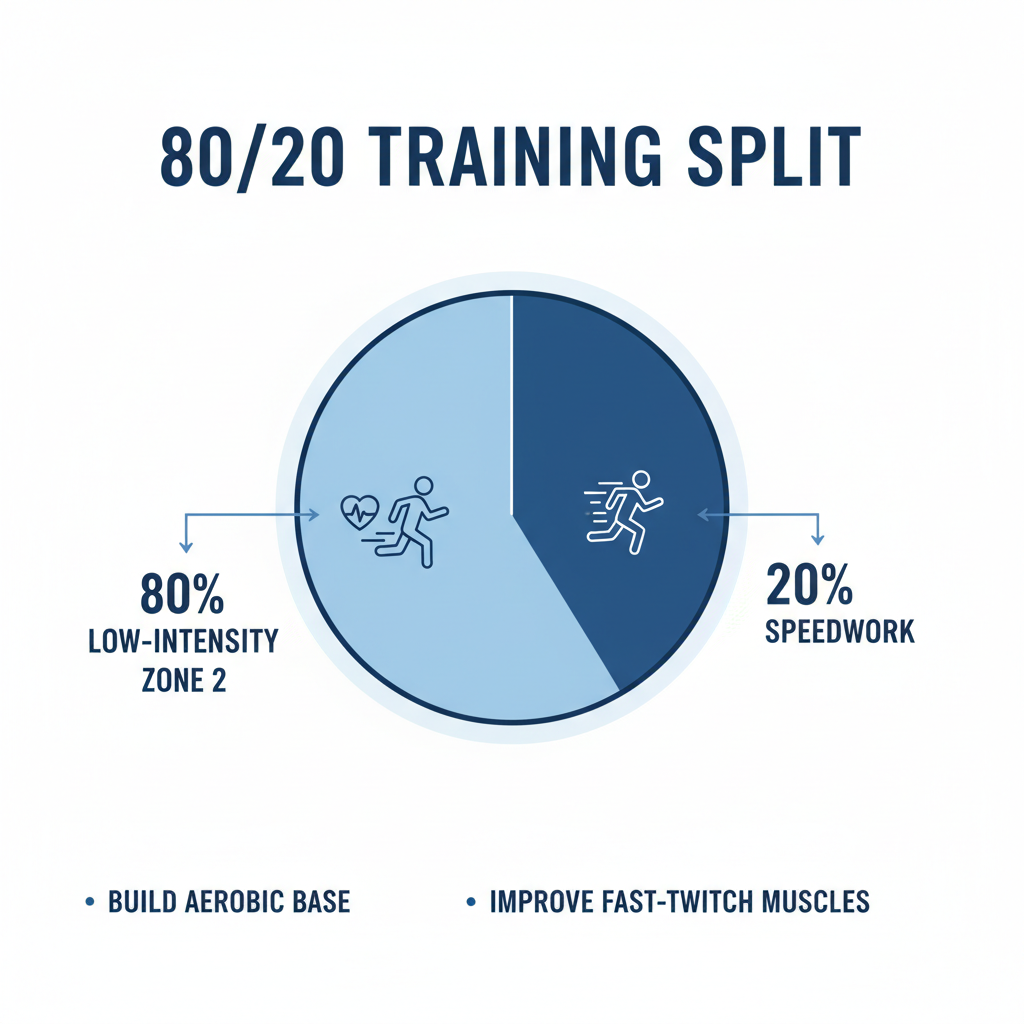
Here’s the concept in a nutshell: Elite runners spend approximately 80% of their training time at low intensity and only 20% at high intensity.
Not 50/50. Not 60/40. But a whopping 80% of their time running easy.
This isn’t just anecdotal wisdom passed down from coach to coach. This is hard science, backed by decades of research. Stephen Seiler’s work on polarized training is one of the clearest modern references for why this distribution works so well (Seiler overview). Exercise physiologist Stephen Seiler spent years studying the training habits of elite endurance athletes across multiple sports—running, cycling, cross-country skiing, rowing. His findings were remarkably consistent across all disciplines: the world’s best endurance athletes overwhelmingly follow this 80/20 distribution.
But here’s what’s truly fascinating: when Seiler looked at recreational runners, he found something entirely different. Most amateur runners train in what he calls “the black hole”—a murky middle ground where every run is moderately hard. They’re not going easy enough to build aerobic base, and they’re not going hard enough to truly stimulate adaptation. It’s the athletic equivalent of spinning your wheels.
I used to live in that black hole. Every run felt like a 7 out of 10 on the effort scale. I was always tired, my times had plateaued, and I couldn’t figure out why I wasn’t improving despite running six days a week.
Then I discovered the 80/20 approach and implemented Zone 2 training for runners into my routine. The transformation wasn’t overnight, but it was real. Within a few months, I was running faster race times while feeling fresher and more energized on my daily runs.
So why does this work so well? It comes down to a beautiful synergy:
The 80% enables the 20%.
When you keep the vast majority of your training in Zone 2, you’re building that massive aerobic engine we talked about earlier—developing mitochondria, growing capillary networks, teaching your body to burn fat for fuel. You’re also recovering properly between your hard sessions.
This means that when it’s time for your 20% high-intensity work—your track intervals, your tempo runs, your hill sprints—you’re actually fresh enough to hit those sessions with quality. You can run faster, maintain better form, and push harder because you haven’t been grinding yourself into the ground with moderate-effort runs every day.
Think of it this way: your Zone 2 training builds the engine, and your high-intensity training tunes it for maximum performance. You need both, but they need to be in the right proportion.
The research supports this approach. Studies have shown that when recreational athletes switch from their typical moderate-intensity training to a polarized 80/20 model, they see significant improvements in performance, even when total training volume remains the same. One study published in the Journal of Applied Physiology found that trained athletes who adopted polarized training improved their 10K times by an average of 5%, while those who continued with threshold-heavy training saw no improvement.
The message is clear: if you want to race fast, you need to train slow most of the time. It feels counterintuitive, especially when your running buddies are hammering every group run. But the evidence is undeniable, and the elites who consistently reach the podium have already figured this out.
Now that you understand why zone 2 training for runners is so powerful and how it fits into the broader 80/20 framework, let’s get practical. How do you actually implement this approach in your own training?
How to Find Your Exact Zone 2 Pace and Heart Rate
You do not need perfect lab data to start. What you need is a repeatable way to keep easy runs truly easy.
Use This Decision Tree
- If you have a reliable chest strap and lactate-threshold data, anchor Zone 2 to heart rate.
- If you want a fast starting point today, use the Maffetone 180-minus-age formula.
- If your devices are unreliable or you prefer a simpler approach, use the Talk Test and confirm it with RPE.
Heart Rate Beats Pace on Most Easy Days
Pace changes with hills, heat, fatigue, terrain, and wind. Heart rate usually reflects the physiological cost more honestly, which is why it is often the best ceiling for easy running.
A Practical Starting Range
Start with Maffetone’s 180 formula, then create a working range about 10 beats below that ceiling. If you are returning from injury, coming back from a long layoff, or getting sick often, subtract another 5. If you have been training consistently for years without setbacks, adding 5 can be a reasonable experiment. Use that number as a starting point, not a permanent identity.
Confirm It With Feel
On a true Zone 2 run, you should be able to speak in full sentences, keep your shoulders relaxed, and finish feeling like you could keep going. If the watch says you are in range but your breathing feels ragged, trust your body over the device.
Navigating Cardiac Drift
Picture this: You’re 45 minutes into a beautiful, steady long run. You’ve locked into a pace that feels completely comfortable, and your breathing is rhythmic and controlled. But then, you glance down at your watch. Your heart rate has slowly crept up from 140 bpm to 155 bpm, yet your pace hasn’t changed by a single second. Panic sets in. Am I losing fitness? Did I go out too fast?
Take a deep breath. What you are experiencing is a very common, entirely normal physiological phenomenon known as cardiac drift (or cardiovascular drift). When you dive deep into Zone 2 training for runners, understanding cardiac drift is absolutely crucial for your sanity.
As you run, a few things happen inside your body. Your core temperature naturally rises, and you lose fluid through sweat. To keep you from overheating, your body redirects blood to the surface of your skin to help cool you down. Because more blood is being diverted to your skin, there is slightly less blood returning to your heart. To maintain the exact same cardiac output—keeping your hard-working muscles fueled with the oxygen they need—your heart has to beat a little faster to compensate.
Hence, the upward drift.
It is not a sign that your aerobic fitness is plummeting, nor does it mean you are accidentally slipping into Zone 3. It is simply your body’s internal air conditioning system kicking into gear.
When to Ignore the Monitor and Trust Your Feel
So, how should you handle cardiac drift? The biggest mistake I see endurance athletes make is frantically slowing down to keep their heart rate glued to a specific number, eventually breaking into a ridiculous, unnatural shuffle just to appease their wrist watch.
Here is my practical, experience-backed advice: start your run guided by your heart rate monitor. But once you hit the 30 to 45-minute mark, and your effort level feels exactly the same as it did at minute five, it’s time to shift your focus.
If your breathing remains rhythmic, your muscles feel fresh, and you can still easily pass the ‘Talk Test’—ignore the heart rate monitor and switch entirely to RPE (Rate of Perceived Exertion). Stay focused on how your body feels rather than chasing a static number. Your watch is a fantastic tool to help you learn what Zone 2 feels like, but it shouldn’t be a cruel master that forces you into an awkward, slow-motion panic. Trust your body’s perceived effort, respect the drift, and keep running strong.
The 5 Most Common Zone 2 Mistakes Runners Make
Let’s be honest: mastering Zone 2 training for runners is harder than it looks. You’d think running slow would be the easiest thing in the world, but it’s surprisingly challenging—especially for type-A athletes.
I get it. There’s a massive ego struggle when you’re out there running a pace that feels embarrassingly slow. You might even find yourself secretly hoping none of your running friends drive by and see you shuffling along at what looks like a recovery pace. And don’t even get me started on the frustration of bad data—when your heart rate monitor is giving you wonky readings and you have no idea if you’re actually in the right zone.
But here’s the truth: the runners who succeed with Zone 2 are the ones who learn to troubleshoot these common pitfalls early. Let’s dive into the mistakes I see most often so you can avoid them.
1. Letting Your Ego Dictate Your Pace
We’ve all been there. You step out the door for an easy run, the sun is shining, your legs feel fresh, and suddenly you’re flying down the bike path at a pace that feels effortless. Or maybe you’re running with a friend who’s slightly faster than you, and you don’t want to be the one huffing and puffing to keep up.
It’s human nature. Our ego wants us to prove something with every single run.
But here’s the truth: leaving your ego at the door is one of the hardest but most important skills you’ll develop as a runner.
When you implement Zone 2 training for runners, you’ll likely encounter days where your prescribed pace feels almost ridiculously slow. You might find yourself thinking, “I can go faster than this. What will the neighbors think?” Or worse, you might glance at your Strava feed and feel the urge to push the pace so your splits look impressive.
This ego-driven mindset is sabotage for your aerobic development.
Remember what we covered earlier: Zone 2 isn’t about looking fast or feeling tough. It’s about building that massive aerobic engine through patience and discipline. When you let your ego dictate your pace—pushing into Zone 3 or 4 on days meant for recovery—you’re effectively stealing from your own progress.
I’ve been guilty of this myself. Early in my training journey, I’d head out for “easy runs” that mysteriously turned into tempo efforts because I felt good. The result? I was constantly fatigued, my race times plateaued, and I couldn’t figure out why my hard workouts felt impossible.
The moment I committed to truly easy running—swallowing my pride when a 10:30 pace was what my heart rate demanded—everything changed. My fitness skyrocketed, my recovery improved dramatically, and I actually started enjoying my training again.
Here’s your action step: Before every easy run, remind yourself of the purpose. Is today’s goal to build your aerobic base? Then respect the zone. If you feel fantastic and want to push, save that energy for your designated speed workouts.
True strength isn’t about going hard every single day—it’s about having the discipline to go easy when it matters most. Your future, faster self will thank you for it.
2. Relying Solely on Wrist-Based Heart Rate Monitors
If you’re serious about Zone 2 training for runners, I need to tell you something that might save you months of frustration: your fancy new GPS watch with the optical heart rate sensor? It’s probably lying to you.
I hate to be the bearer of bad news, especially when you just dropped $400+ on a shiny new running watch. But if you’re relying solely on wrist-based heart rate monitoring to stay in Zone 2, you might be working with flawed data.
The Cadence Lock Problem
Here’s what’s happening on your wrist: optical heart rate sensors work by shining light into your skin and detecting blood flow changes. It’s clever technology, but it has a significant Achilles’ heel—something called “cadence lock.”
Cadence lock occurs when your watch mistakes your arm’s movement (your running cadence) for your heart rate. Your watch essentially gets confused between the rhythmic bouncing of your arm and the rhythmic pumping of your heart. The result? Your watch might display 160 bpm when your actual heart rate is only 140 bpm—or worse, show 130 bpm when you’re actually at 165 bpm.
This isn’t a rare occurrence. Studies have shown that wrist-based heart rate monitors can be off by 10-20 beats per minute during running, and cadence lock can happen during any run, at any pace.
Why This Matters for Zone 2
When you’re targeting Zone 2, precision matters. We’re talking about a window that might only be 10-15 beats per minute wide. If your watch is off by 15 bpm due to cadence lock, you could think you’re nailing your Zone 2 run when you’re actually deep in Zone 3—or vice versa.
I’ve seen runners push themselves too hard for months, wondering why they weren’t seeing the benefits of Zone 2 training for runners, only to discover their watch was underreporting their heart rate by 20 bpm. That’s the difference between an easy aerobic run and a moderate tempo effort.
The Solution: Chest Strap Heart Rate Monitors
If you want reliable, accurate heart rate data—and for Zone 2 training, you absolutely do—you need a chest strap heart rate monitor. These devices measure the electrical signals from your heart (like an EKG), not optical blood flow changes.
Two recommendations I stand behind:
-
Polar H10: Often considered the gold standard for heart rate accuracy in the running community. It’s comfortable, reliable, and compatible with most GPS watches and apps.
-
Garmin HRM-Pro: If you’re already in the Garmin ecosystem, this is a fantastic choice. It also tracks running dynamics, which can be useful for form analysis.
Yes, it means wearing an extra piece of equipment. Yes, it’s another thing to charge and keep clean. But the data accuracy is worth every penny and every small inconvenience.
A Practical Approach
If you’re not ready to invest in a chest strap, I understand. Here’s my compromise: use the Talk Test (which we discussed earlier) as your primary Zone 2 guide, and treat your wrist-based heart rate data as a rough estimate, not gospel truth.
But if you’re committed to optimizing your training and getting the most out of every run, a chest strap is one of the best investments you can make in your running journey. Think of it this way: you wouldn’t navigate a new city with a broken compass. Why would you train your body with inaccurate data?
3. Ignoring Fueling Because ‘It’s Just an Easy Run’
Here’s a trap I see runners fall into all the time, and honestly, it’s one I used to fall for myself. You’re heading out for a “just an easy Zone 2 run,” so you grab your shoes, maybe a sip of water, and head out the door without a second thought about fueling. After all, it’s not a tempo run or a race—it’s just a slow, comfortable jog, right?
Well, not exactly.
The myth goes something like this: because Zone 2 training for runners primarily utilizes fat oxidation for energy, you don’t need to worry about taking in carbohydrates or electrolytes. Your body has plenty of stored fat to burn, so why bother with gels or sports drinks?
There’s a kernel of truth here, which is what makes this myth so convincing. Yes, Zone 2 running does rely heavily on fat as a fuel source. In fact, that’s one of the beautiful adaptations of training at this intensity—your body becomes incredibly efficient at burning fat for fuel. But here’s where the logic breaks down: efficient fat burning doesn’t mean exclusive fat burning, and it certainly doesn’t mean your body doesn’t need support.
Let’s break this down practically.
The Carbohydrate Reality: Even in Zone 2, your body is still burning a mix of fat and carbohydrates. The percentage shifts toward fat, yes, but you’re still using glycogen (stored carbohydrates) to some degree. When you’re out there for 75, 90, or 120+ minutes, that glycogen depletion adds up. I’ve seen countless runners bonk on long easy runs because they assumed they didn’t need any carbs. They’d call me confused: “But I was in Zone 2 the whole time! How did I run out of gas?”
The answer is simple: your body still needs some carbohydrate support, even at lower intensities. For runs under 60-75 minutes, you’re generally fine with whatever you ate beforehand. But once you start creeping past that 75-90 minute mark, I strongly recommend incorporating some simple carbohydrates—maybe 30-60 grams per hour, depending on your size and the duration. This could be a gel, some chews, or even real food if your stomach tolerates it.
The Electrolyte Equation: This is arguably even more important, and it’s the one most runners completely overlook. Just because you’re running easy doesn’t mean you aren’t sweating. Electrolytes—particularly sodium, potassium, and magnesium—are critical for muscle function, nerve signaling, and fluid balance regardless of your pace.
I learned this lesson the hard way a few years back. I went out for a planned 2-hour Zone 2 run on a warm morning. I figured, “It’s just an easy run, I’ll be fine with water.” By the 90-minute mark, I had a dull headache forming. By 105 minutes, my legs felt oddly heavy despite my heart rate being well within Zone 2. I ended up walking the last mile home, feeling completely depleted. The culprit? Dehydration and electrolyte imbalance. My pace was easy, but my sweat loss was real.
Now, I treat every run over 60 minutes—regardless of intensity—with the same respect for hydration and electrolyte replacement. A simple electrolyte drink or tablet in my water bottle has made a world of difference.
Practical Fueling Guidelines for Zone 2 Runs:
- Under 60 minutes: Water is generally fine. Maybe a small pre-run snack if you haven’t eaten in a while.
- 60-75 minutes: Water with electrolytes. Consider a small carb source if you’re running on an empty stomach.
- 75-120 minutes: Water with electrolytes plus 30-40 grams of carbohydrates per hour.
- 120+ minutes: Full fueling protocol—electrolytes, 40-60 grams of carbs per hour, and potentially some protein for ultra-long efforts.
The Bottom Line: Your Zone 2 long runs are where you build your aerobic engine, and they deserve the same nutritional respect as your harder workouts. Think of fueling as part of the training itself—practicing your race-day nutrition strategy during these long, easy runs is invaluable. Your stomach can adapt to processing fuel while running, but only if you give it the opportunity to practice.
Don’t let the “easy” in easy run fool you. Respect the duration, honor your body’s needs, and fuel accordingly. Your legs—and your overall progress—will thank you.
4. Forgetting to Train by Feel
I learned this lesson the hard way during a 20-mile long run last fall. About 12 miles in, my watch died. No warning, no low battery alert—just a black screen. Panic set in immediately. How would I know if I was in Zone 2? Was I going too fast? Too slow?
But here’s what happened: I had one of the best final 8 miles of my life. I tuned into my breathing, paid attention to how my legs felt, and actually enjoyed the run instead of stress-checking my wrist every 30 seconds.
Here’s the reality: Gadgets fail. Batteries die, chest straps lose connection, optical sensors get confused by cold weather or sweat, and sometimes you just forget to charge the darn thing.
This is why developing your internal Zone 2 compass is non-negotiable. When you practice Zone 2 training for runners correctly, you’re building an intuitive sense of effort that no piece of technology can replicate.
So what does Zone 2 feel like?
- Breathing: Rhythmic and fully controlled. You could breathe through your nose if required (though I don’t insist on exclusive nasal breathing)
- Conversation: You can speak in full sentences without hunting for air
- Muscles: Working but not heavy or accumulating burn
- Mindset: Comfortable enough that you could maintain this pace for hours
Practice this: Once a week, leave the watch at home. Run by feel alone. Guess your effort level before you finish, then honestly assess: Could I truly hold this conversation?
This internal awareness is what separates dependent runners from resilient athletes.
5. Fearing the ‘Slowdown’ Phase
Here is a reality check that catches almost every athlete off guard: when you first start implementing dedicated Zone 2 training for runners, your easy pace might not just feel incredibly slow—it might actually get slower before it gets faster.
If you have spent months or years pushing the pace on your daily runs, you are likely walking around with a fair amount of latent fatigue. When you finally force yourself to slow down and stay aerobic, your body begins to offload that deep exhaustion. As a result, you might find that a heart rate of 140 bpm yields a 10:00 pace in week one, but only yields a 10:30 pace in week three.
I remember looking down at my watch during my first dedicated block of Zone 2 work and feeling completely defeated. My pace had slowed to an embarrassing shuffle. But here is the science-backed truth: this temporary slowdown is actually a sign that the system is working. You are finally addressing your aerobic deficit.
You are in the thick of the adaptation process. Building those dense networks of capillaries and powerhouse mitochondria takes time. During these initial weeks, your body is essentially rebuilding the engine while the car is still running. It requires a massive amount of internal energy, leaving less energy available for raw speed.
Please, do not panic and abandon the process when the pace drops. Embrace the slowdown phase for what it truly is: a necessary biological investment. If you can detach your ego from your pace and trust the process for 8 to 12 weeks, you will eventually reach a tipping point. One day, you will look down and realize that your heart rate is holding steady, your breathing is effortless, and your pace is naturally starting to creep back up—faster than it ever was before.
How to Implement Zone 2 Training Into Your Schedule This Week
Enough theory. Let’s get you out the door and actually doing this.
I know what it’s like to read about a training philosophy, feel incredibly motivated, and then completely freeze when it comes time to actually apply it. You’re excited, but you’re also staring at your training plan wondering, “Where does this even fit?”
Don’t worry. I’ve got you. Here’s a simple, actionable framework to start implementing Zone 2 training for runners this week—no matter what your current schedule looks like.
The Beginner’s Blueprint (3-4 Runs Per Week)
If you’re running 3 to 4 times per week, here’s your simple transition plan:
Week 1-2:
- 3 runs: Make ALL of them Zone 2. Yes, all three. Remember, you’re building the foundation. The aerobic base you’re developing right now is what everything else will be built on.
- Pace check: Use the Talk Test for every run. If you can’t recite a full paragraph comfortably, slow down.
- Duration: Keep your normal run durations—just change the intensity.
Week 3-4:
- 3 runs: 2 Zone 2 runs, 1 shorter run with some strides or light pickups at the end (15-20 seconds of faster running, with full recovery between each)
- Goal: Start introducing a tiny bit of speed while maintaining your aerobic focus
The Intermediate Plan (5-6 Runs Per Week)
If you’re already running 5 or 6 days a week, the transition looks a little different:
This week, try this:
- 4 runs: Dedicated Zone 2 (these become your bread and butter)
- 1 run: Easy run with 4-6 x 20-second strides at the end
- 1 run: Workout day (tempo, intervals, or fartlek—this is where you get your 20% intensity)
The Advanced Athlete (Triathletes & High-Volume Runners)
For those of you already training 10+ hours per week across multiple disciplines:
- Immediately shift 80% of your total training volume into Zone 2. For a triathlete training 12 hours per week, that means roughly 9.5 hours should be at this aerobic intensity.
- Keep your existing quality sessions (track workouts, threshold sets, swim intervals) as your 20%. Don’t touch those yet.
- The magic happens in the in-between: Those recovery spins, easy jogs, and long slow distance workouts? They all become strictly Zone 2.
Your Action Plan for THIS Week
Here’s your homework. I want you to treat this like an experiment—approach it with curiosity, not pressure.
Step 1: Choose your measurement method
- If you have a chest strap heart rate monitor: Use it. Calculate your Zone 2 heart rate using the Maffetone formula we discussed earlier.
- If you don’t have a reliable HR monitor: Commit to the Talk Test for every single run this week. No exceptions.
Step 2: Plan your week
- Look at your schedule for the next 7 days
- Identify which runs will be Zone 2 (hint: most of them)
- Write it down. Commit to it. Tell a friend or training partner if you need accountability.
Step 3: Run your first intentional Zone 2 session
- Leave your ego at the door
- Start slower than you think you need to
- Check in with your breathing every 5 minutes
- If using heart rate, don’t panic if you need to walk up hills to stay in zone—this is normal!
Step 4: Track how you feel
- After each run, jot down a quick note: How did the pace feel? What was your breathing like? Did you enjoy it?
- Pay special attention to how you feel the next day. You might be surprised by how fresh your legs feel.
A Quick Reality Check
The first 2-3 weeks of proper Zone 2 training for runners can feel frustrating. Your pace might be slower than you’re used to. You might feel like you’re “not doing enough.” You might even question whether this whole thing is a waste of time.
It’s not.
Trust the process. Trust the science. Trust that every slow, easy mile is building an aerobic engine that will eventually power you to faster race times, quicker recovery, and a longer, healthier running career.
The athletes I’ve seen succeed with this approach aren’t the ones who naturally love running slow—they’re the ones who committed to the process even when their ego screamed at them to speed up.
Your challenge starts this week. Let’s see what happens when you finally give your body the aerobic base it’s been begging for.
A Practical Week of Training (Sample Schedule)
Enough theory—let’s get practical. I want to show you exactly what a balanced training week looks like when you’re implementing Zone 2 training for runners properly.
Below is a sample 5-day running week that follows the 80/20 principle. I’ve designed this to be adaptable, whether you’re a beginner building your base or an advanced runner training for a marathon. The key is seeing how Zone 2 runs support—and actually enhance—your higher-intensity work.
The Sample Week
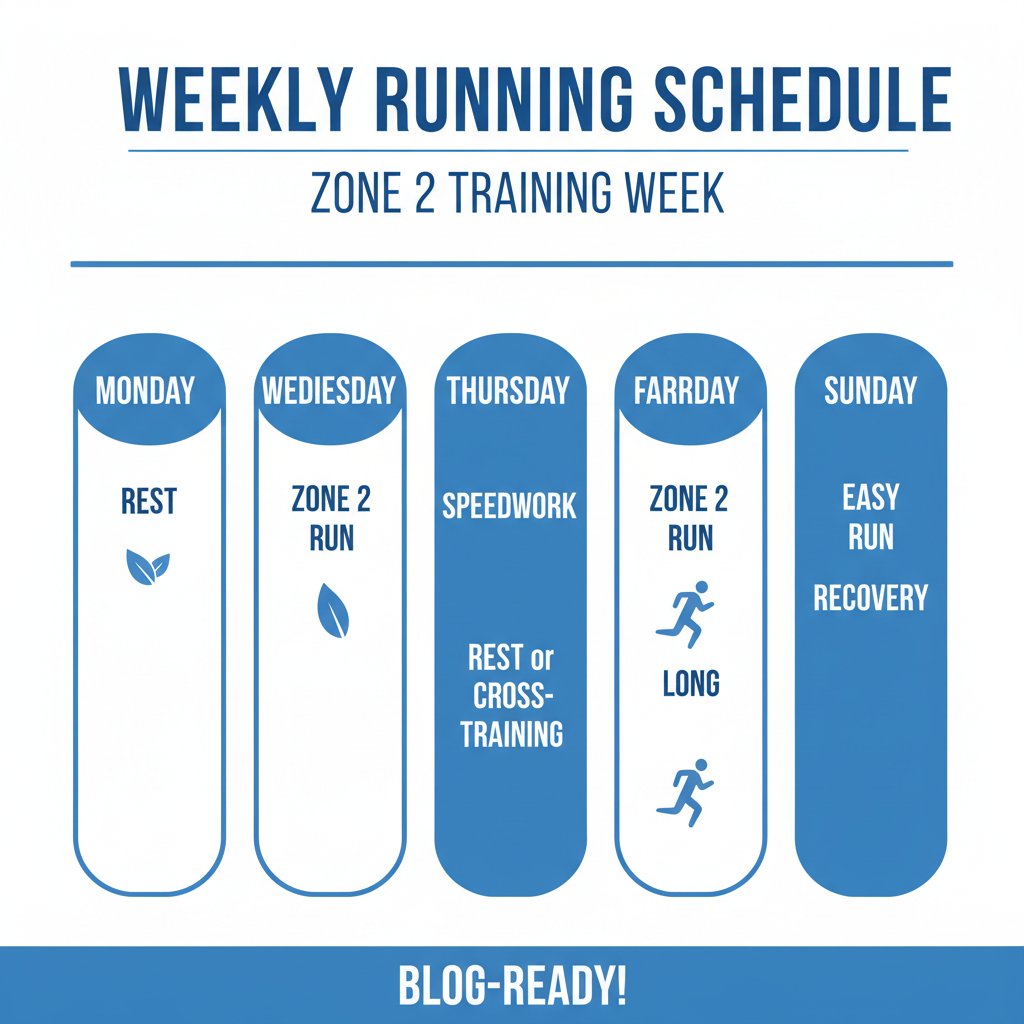
Monday: Rest or Active Recovery
Take the day off completely, or do some gentle mobility work, yoga, or a walk. Your body adapts and gets stronger during rest, not during the workout itself. If you want a simple warm-up flow, pair this with Dynamic Stretching for Runners.
Tuesday: Zone 2 Base Run
- Beginner: 30–40 minutes
- Intermediate: 45–60 minutes
- Advanced: 60–75 minutes
This is your bread and butter. Lock into your Zone 2 heart rate or use the Talk Test. Focus on maintaining a conversational pace throughout. This run builds your aerobic engine.
Wednesday: Speedwork / High-Intensity Day
- Beginner: 20-minute warm-up (easy jog) + 6 x 400m repeats at 5K pace (90 sec recovery jog between) + 10-minute cool-down
- Intermediate: 15-minute warm-up + 8 x 400m or 5 x 800m at 5K pace (2 min recovery) + 10-minute cool-down
- Advanced: 15-minute warm-up + 6 x 800m or 4 x 1K at 5K-10K pace (2-3 min recovery) + 15-minute cool-down
This is where you get fast. These intervals should feel challenging—pushing your VO2 max and anaerobic threshold. Notice how the Zone 2 run yesterday left your legs fresh enough to actually hit these paces? If you race triathlon, Mastering Brick Workouts is a useful companion for the quality day.
Thursday: Rest or Cross-Training
Take a full rest day, or do some low-impact cross-training like cycling, swimming, or elliptical. If you cross-train, keep it easy—this isn’t the day to push.
Friday: Zone 2 Base Run
- Beginner: 30–40 minutes
- Intermediate: 45–60 minutes
- Advanced: 60–75 minutes
Back to the slow stuff. Your legs might feel a little heavy from yesterday’s speedwork—that’s normal. Don’t force the pace. Let your heart rate guide you, even if that means running slower than usual.
Saturday: Long Run (Primarily Zone 2)
- Beginner: 45–60 minutes
- Intermediate: 75–90 minutes
- Advanced: 90–120+ minutes
This is the cornerstone of Zone 2 training for runners. Your long run should be almost entirely in Zone 2, with maybe a few surges or strides at the end if you’re feeling spicy. This builds endurance, fat oxidation, and mental toughness for race day.
Sunday: Rest or Optional Easy Recovery Jog
- Beginner: Full rest
- Intermediate/Advanced: 20–30 minutes very easy jog (Zone 1) or full rest
Listen to your body. If you’re feeling wiped, take the day off completely. If you’re feeling good and want to shake out the legs, a super easy 20-minute jog can help with recovery.
Making It Work for You
A few quick notes on adapting this schedule:
- If you run 3–4 days per week, simply remove one of the Zone 2 days and keep the speed session and long run. Those are your non-negotiables.
- If you’re training for a specific race, you can adjust the Wednesday speedwork to match your event (tempo runs for half-marathoners, long intervals for marathoners, etc.).
- If you’re a triathlete, swap one or two of the easy runs for easy bike rides or swims at the same Zone 2 intensity. The aerobic adaptations transfer across sports.
The beauty of this structure is its simplicity. You’re getting plenty of low-intensity volume to build your aerobic base, while still hitting the high-intensity work that makes you fast. It’s the same basic formula that elite runners have used for decades, and it works just as well for the rest of us.
FAQ: Zone 2 Training for Runners
How long does it take for Zone 2 pace to improve?
Most runners notice better pace at the same heart rate after 4 to 8 consistent weeks, especially if they stop turning every easy run into a moderate effort.
Should I walk hills to stay in Zone 2?
Yes. On steep climbs, walking is often the smartest way to keep the effort aerobic instead of accidentally turning the run into threshold work.
Can I do Zone 2 without a heart rate monitor?
Absolutely. The Talk Test and a relaxed RPE are good enough to build your base if you stay disciplined about keeping the effort conversational.
How many Zone 2 runs should I do each week?
For most runners, 3 to 5 easy aerobic sessions work well, with only 1 or 2 truly hard sessions layered on top.
Conclusion: Trusting the Process and Embracing the Slow
If you take one thing away from this entire guide, let it be this: slowing down on your easy days is the absolute best way to ensure you have the endurance and fresh legs to hit your fastest speeds on race day. It sounds counterintuitive, I know. But the science is clear, and decades of elite training data back it up.
When you embrace Zone 2 training for runners, you’re not taking the easy way out—you’re training smarter. You’re building the cellular machinery (those beautiful mitochondria and capillaries) that will eventually allow you to sustain faster paces for longer. You’re recovering properly so that when it is time to push hard during interval sessions, you actually have the energy to do so.
The hardest part? Trusting the process.
There will be days when your Zone 2 pace feels absurdly slow. There will be moments when you question whether this whole “easy running” thing is actually working. There will be runs where your ego screams at you to pick up the pace because the runner next to you is definitely going faster.
Ignore that voice.
Stay patient. Stay consistent. Trust that beneath the surface, your body is quietly building an aerobic engine that will carry you to new personal bests. Every easy mile is a deposit in your endurance bank account—and come race day, you’ll be incredibly glad you made those deposits.
You don’t have to be perfect at this. Even shifting most of your easy runs to true Zone 2 will yield massive benefits. Progress isn’t about perfection; it’s about direction.
So here’s my challenge to you: This week, try just ONE run strictly using the Talk Test. Leave the watch at home if you have to. Run at a pace where you could comfortably hold a full conversation. Pay attention to how your body feels before, during, and after.
Then, come back here and share your experience in the comments below. Did it feel weird? Did it feel too easy? Did you notice anything surprising? I want to hear about it.
Your future, faster self will thank you for embracing the slow.
Happy running! 🏃♂️