Pick almost any starting line in 2026 and you will see the same two wrists: a Garmin on the serious-training crowd and a COROS or an Apple Watch on the rest. For a couple of years the running-watch question was basically Garmin or Apple. It is not anymore. COROS has quietly become the only brand that beats Garmin on the things runners used to switch for — battery life, weight, and price — while matching them on GPS accuracy. So if you are shopping the best GPS running watches 2026 has on offer, this is the wider field, and the one I send people to when they want every option on the table.
If you already know your decision is Garmin-vs-Apple, I did that head-to-head in detail in Garmin vs Apple Watch: which is best for running. This guide adds COROS, widens the Garmin lineup, and tells you exactly which model fits which kind of runner. The short version up front: the Garmin Forerunner 265 is the best overall running watch, the COROS Pace 3 is the best value watch with the best battery life, and the Apple Watch Ultra 2 is still the best smartwatch that also happens to run.
Disclosure: Some links are affiliate links. As a partner of the brands mentioned, I may earn a commission from qualifying purchases at no extra cost to you. It never changes what I recommend — I only link watches I would actually wear.
The 30-second picks
If you have no patience for 2,500 words, here is the table. Everything below it is the reasoning.
| Watch | Price | Battery (smartwatch) | Battery (GPS) | Best for |
|---|---|---|---|---|
| Garmin Forerunner 265 | ~$450 | 13 days | 20 h | Best overall |
| Garmin Forerunner 965 | ~$600 | 23 days | 31 h | Maps + multiband without the Fenix price |
| Garmin Fenix 8 (47mm AMOLED) | ~$1,000 | 16 days | 29 h | Premium build, ultras, diving |
| Garmin Forerunner 165 | ~$250 | 11 days | 19 h | Best value Garmin, AMOLED entry |
| COROS Pace 3 | ~$219 | 24 days | 30 h | Best value overall, lightest, huge battery |
| COROS Apex 2 Pro | ~$399 | 30 days | 75 h | Long battery, sapphire, titanium |
| Apple Watch Ultra 2 | ~$799 | 36 h (72 h low-power) | up to 72 h low-power | Best smartwatch for running |
Prices are 2026 USD MSRP and move with sales. Battery numbers are the manufacturer figures for the relevant size and mode — real-world GPS battery runs about 10–15% lower, which I factor into the recommendations.
Best overall: Garmin Forerunner 265
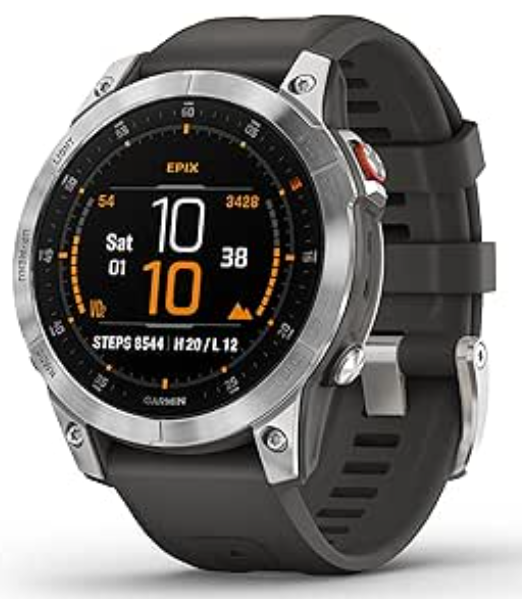
If I had to hand one watch to one runner and never think about it again, it would be the Garmin Forerunner 265. Around $450, an AMOLED screen bright enough to read in Barcelona midday sun, 13 days in smartwatch mode and 20 hours of continuous GPS — enough for a marathon with a wide margin, and enough for most ultramarathon training weeks on a single charge. It has multiband GPS (Garmin calls it SatIQ, which auto-switches to multiband only when you need it to save battery), so tree cover and downtown canyons between here and the Helsinki start line do not bend your track.
The reason it wins overall is the metrics. Training Status, Training Load Focus, Recovery Time, HRV Status, Body Battery, Race Predictor — for a structured marathon block, it is hard to beat. You wake up, glance at Body Battery and Recovery Time, and the watch tells you whether today is a hard day or an easy day. That is not a gimmick; over a 16-week build it is the difference between arriving at the start line fit or arriving overcooked. I covered exactly this in the Garmin-vs-Apple piece, and the conclusion has not changed: if running is the point of the watch, the 265 is the sweet spot.
The only real argument against it is that it lacks on-board maps. If you need turn-by-turn navigation on the watch, jump to the Forerunner 965 below.
Best premium: Garmin Forerunner 965 (and Fenix 8 for ultras)
The Forerunner 965 is what happens when you take the 265 and add the two things serious runners eventually want: full topographic maps with turn-by-turn navigation, and a bigger 23-day / 31-hour battery. At ~$600 it is the watch I would buy if I ran a lot of unfamiliar trails, raced abroad often, or just did not want to plan a route on my phone ever again. The map alone is worth the premium if you regularly find yourself in a new city wondering which dirt track actually goes somewhere.
The Fenix 8 is the other premium option, at ~$1,000, and it is a different proposition. It is built like a tank — titanium, sapphire, dive-rated to 40 m, with a mic and speaker for calls and voice notes. Battery on the 47mm AMOLED is 16 days smartwatch / 29 hours GPS (the MIP/solar Fenix 8 variants stretch much further if you do not want AMOLED). You buy the Fenix 8 if you want one watch for running, hiking, diving, and a decade of abuse — not because you need it to run a faster 10K. For most runners the 965 is the smarter spend; the Fenix is for the person who genuinely uses the rugged features.
Best value Garmin: Forerunner 165
The Forerunner 165 is the entry point that is still a real running watch, not a fitness band with delusions. At ~$250 you get the same bright AMOLED screen as the 265, 11 days smartwatch / 19 hours GPS, wrist heart rate, and Garmin’s core training metrics. It is the watch I would put on a friend who is three months into running and starting to care about pace and heart rate.
The cut is multiband GPS — the 165 does not have it. On open roads you will not notice. On dense urban trails or heavy tree cover you will see slightly wobbly lines compared to the 265. It also skips the deeper recovery metrics (no Training Load Focus, no Body Battery at the full resolution of the 265). If you are coming from nothing, none of that matters — and when you outgrow it in a year, you will know exactly which features to upgrade for. That is the cleanest upgrade path in the lineup, and it is why this is the best value Garmin, full stop.
If you are even newer than that and not sure you will stick with running, the full best running watches for beginners guide breaks down what a first watch actually needs before you spend anything.
Best COROS: Pace 3 and Apex 2 Pro
This is where the list gets interesting. The COROS Pace 3 costs ~$219, weighs 30 grams, runs 24 days in smartwatch mode and 30 hours of GPS, and has multiband dual-frequency GPS. On paper that undercuts the Garmin Forerunner 165 while beating the Forerunner 265 on battery and weight. It is genuinely the best value GPS running watch you can buy in 2026, and it is not close.
What you give up is the depth of Garmin’s metrics. COROS’s EvoLab engine gives you Training Load, Baseline, HRV, and a Recovery Load score — it is good, and cleaner to read than Garmin Connect, but it is shallower than Garmin’s Training Status plus Load Focus plus Body Battery stack. The app is leaner, the ecosystem is smaller, and there are fewer third-party integrations. None of that matters for 90% of runners. If you want a watch that disappears on your wrist, runs for three weeks, tracks every run accurately, and costs less than a nice pair of race shoes, the Pace 3 is the one.
The COROS Apex 2 Pro is the step up, at ~$399. You get a titanium bezel, sapphire glass, 30 days smartwatch and a class-leading 75 hours of GPS (150 hours in Smart GPS mode), full offline maps with turn-by-turn, and multiband. For an ultrarunner who wants Garmin-grade build and battery without Garmin’s price, the Apex 2 Pro is the most compelling COROS in the lineup. I would put it head-to-head with the Forerunner 965 any day of the week — and on battery alone, it wins.
Best smartwatch: Apple Watch Ultra 2 (and Series 10)
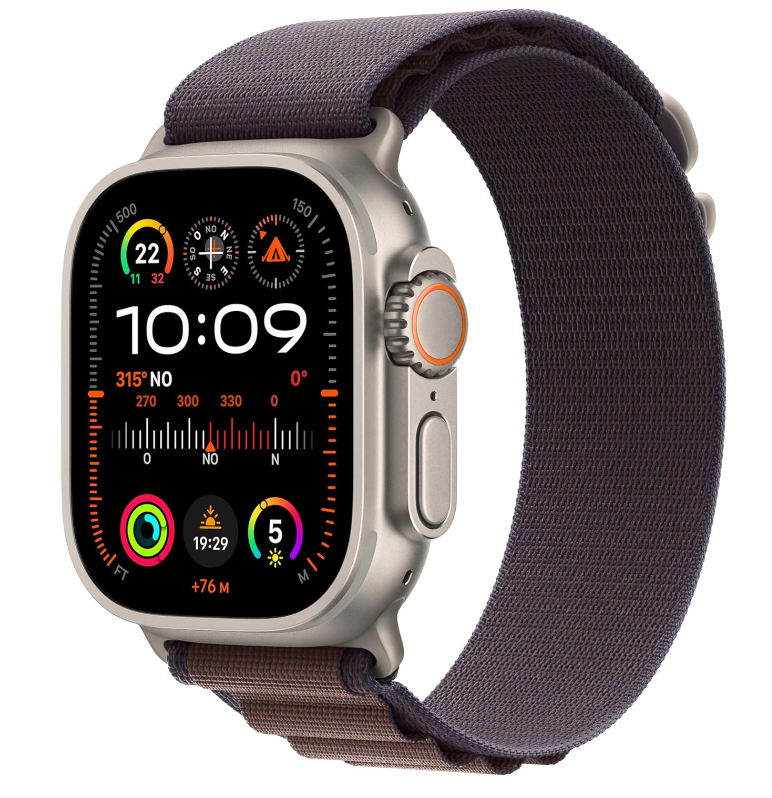
If you carry an iPhone and want one device for everything — running, calls, payments, ECG, sleep, the lot — the Apple Watch Ultra 2 is the best smartwatch that also runs. At ~$799 you get dual-frequency L1+L5 GPS (so it tracks as accurately as any multiband Garmin or COROS), 36 hours of normal battery or 72 hours in low-power mode, the brightest Apple screen yet, and a titanium case. It is the only Apple Watch I would recommend to someone training for a marathon or longer.
The standard Apple Watch Series 10 at ~$399 is the pick for the runner who does 3–5 sessions a week and wants the smartwatch life without the Ultra price. The catch: ~18 hours battery and no multiband GPS, so you charge daily and the GPS line is very good rather than pinpoint. If those two things do not bother you, it is a superb running watch that also happens to be the best smartwatch on the market.
The full argument — training depth, ecosystem, the daily-charging question — is in Garmin vs Apple Watch: which is best for running. The one-line summary: buy Apple if you want one device for your whole life, buy Garmin or COROS if running is the priority.
Garmin vs COROS: head-to-head
This is the comparison the Garmin-vs-Apple guide could not cover. The two running-first brands, on the metrics that actually decide it.
| What matters to runners | Garmin (Forerunner / Fenix) | COROS (Pace / Apex) |
|---|---|---|
| GPS accuracy | Excellent — multiband (SatIQ) across 265/965/Fenix | Excellent — Pace 3 and Apex 2 Pro both multiband |
| Training metrics | Deeper: Training Status, Load Focus, Body Battery, HRV Status, Race Predictor | Strong: EvoLab Training Load, Baseline, HRV, Recovery Load — simpler |
| Battery (GPS) | 20 h (265) / 31 h (965) / 29 h (Fenix 8 AMOLED) | 30 h (Pace 3) / 75 h (Apex 2 Pro) — class-leading |
| Battery (smartwatch) | 11–23 days (Forerunner); 16–28 days (Fenix) | 24–30 days — best in class |
| Weight | Forerunner ~39–53 g; Fenix heavier | Pace 3 30 g — lightest in the sport |
| Ecosystem | Garmin Connect — huge, mature, third-party rich | COROS app + EvoLab — lean, clean, fewer integrations |
| Smart features | Functional: notifications, Garmin Pay, music | Functional but lighter |
| Price range | $250–$1,000 | $219–$399 — undercuts Garmin at every tier |
The honest read: Garmin wins on depth, COROS wins on battery, weight, and price. If you want the richest training analytics and the biggest ecosystem, Garmin. If you want a watch that disappears on your wrist, runs for weeks, tracks every run accurately, and costs less, COROS. There is no wrong answer — these are the two best running-watch companies in the world right now, and choosing between them is a far better problem than the one runners had five years ago.
What runner type are you?
Stop reading spec sheets. Decide what kind of runner you are, and the watch picks itself.
| You are… | Buy this |
|---|---|
| A beginner buying your first GPS watch | COROS Pace 3 or Garmin Forerunner 165 |
| Training for a marathon with a structured block | Garmin Forerunner 265 |
| An ultrarunner or multi-day adventurer | COROS Apex 2 Pro or Garmin Fenix 8 (965 if you want maps without the Fenix price) |
| An iPhone user who wants one do-everything device | Apple Watch Ultra 2 (or Series 10 on a budget) |
| An Android user | Garmin or COROS — Apple Watch will not pair |
| Maximum battery on the smallest budget | COROS Pace 3 |
| Max cushion on training insights and recovery data | Garmin Forerunner 265 (or 965) |
If you are undecided between two, buy the cheaper one. The difference between a great watch and the next great watch is much smaller than the difference between running consistently and not — and no watch fixes the second one.
Features that actually matter in 2026
Most spec sheets are noise. Four things move the needle.
Multiband (dual-frequency) GPS
This is the single biggest GPS improvement in years. Multiband pulls two satellite frequencies instead of one, which is what actually fixes the classic problems — tree cover, tall buildings, bridges. Every premium pick here has it: Garmin 265/965/Fenix, COROS Pace 3/Apex 2 Pro, Apple Watch Ultra 2. The watches that do not (Forerunner 165, Apple Watch Series 10) are still accurate on open roads but wobble in dense cover. If you run trails or cities, prioritise it.
Training load and recovery metrics
This is Garmin’s home turf, and COROS is closer than people think. The point of these metrics is not data for its own sake — it is a coach on your wrist telling you when to push and when to back off. Over a marathon block that guidance is worth more than any single workout. Garmin’s Training Status, Load Focus, Recovery Time, and Body Battery are the deepest stack; COROS’s EvoLab is cleaner and easier to read but slightly shallower; Apple’s Training Load and Vitals (watchOS 11) are useful but the least deep of the three.
Offline maps and navigation
Full topo maps with turn-by-turn are a real advantage if you run new routes, race in unfamiliar cities, or go off-road. The Garmin 965, Fenix 8, and COROS Apex 2 Pro all have it; the Forerunner 265 and Pace 3 do not. If you always run your local routes, save the money. If you scout for races or travel to run, pay for it.
Battery life
Battery is the feature no one cares about until they are 30 km into a long run and the watch dies. For daily training, anything works. For an ultra, a multi-day trek, or a heavy week where you sleep-track every night, the order is clear: COROS Apex 2 Pro (75 h) > COROS Pace 3 (30 h) > Garmin Forerunner 965 (31 h) > Garmin Forerunner 265 (20 h), with Apple Watch bringing up the rear. Indoor runners see a different tradeoff — head to the best treadmills for runners 2026 guide for how a watch fits a treadmill setup, where GPS battery is irrelevant and the smartwatch side matters more.
Frequently asked questions
Garmin or COROS for a marathon?
Either works, but for most runners the Garmin Forerunner 265 is the better marathon watch because of its deeper training and recovery metrics (Training Status, Load Focus, Body Battery, Race Predictor), which genuinely help manage a 16-week build. If you want longer battery and a lower price and do not mind slightly simpler analytics, the COROS Pace 3 is completely up to the job — 30 hours of GPS is a 6-hour marathon with plenty of room to spare.
Do I need multiband GPS in 2026?
If you run only open roads, no — any current watch tracks accurately. If you run trails, dense city canyons, or under heavy tree cover, yes — multiband (dual-frequency) GPS is the feature that actually fixes wobbly tracks, and it is worth paying for. The Garmin 265/965/Fenix, COROS Pace 3/Apex 2 Pro, and Apple Watch Ultra 2 all have it.
Which of these watches have offline maps?
The Garmin Forerunner 965, Garmin Fenix 8, and COROS Apex 2 Pro have full topographic maps with turn-by-turn navigation. The Forerunner 265, Forerunner 165, COROS Pace 3, and Apple Watches do not — they need a phone for routing.
Can I trade in my old running watch?
Garmin and Apple both run trade-in programs that knock roughly 10–20% off a new watch depending on model and condition. COROS does not run an official trade-in but frequently offers upgrade credits if you message support directly. Either way, do not expect much for a 4-year-old watch — the value is in the recycling, not the cash.
How fast do these watches charge?
Fast enough that battery is rarely a real problem with a habit. The COROS Pace 3 tops up from empty to about a week of battery in roughly 30 minutes; the Garmin Forerunner 265 reaches a full charge in around an hour; the Apple Watch Ultra 2 fast-charges to 80% in about an hour. Build a charging habit — shower, post-run, whatever — and the battery numbers matter far less than the spec sheets suggest.
The bottom line
The boring version is the one that works, and in 2026 the boring version is this: buy the Garmin Forerunner 265 if you want the best overall running watch, buy the COROS Pace 3 if you want the best value and the best battery, and buy the Apple Watch Ultra 2 if you want one device for your entire life. Any of the three will track every run accurately for years and outlast the pair of shoes you run in.
If you are still splitting hairs, pair the decision with the best running shoes 2026 guide — the watch tracks the work, the shoes do the work, and together they are 90% of what makes a runner consistent. The other 10% is showing up.
Ready to buy? Garmin direct · COROS direct · Apple Watch on Amazon.