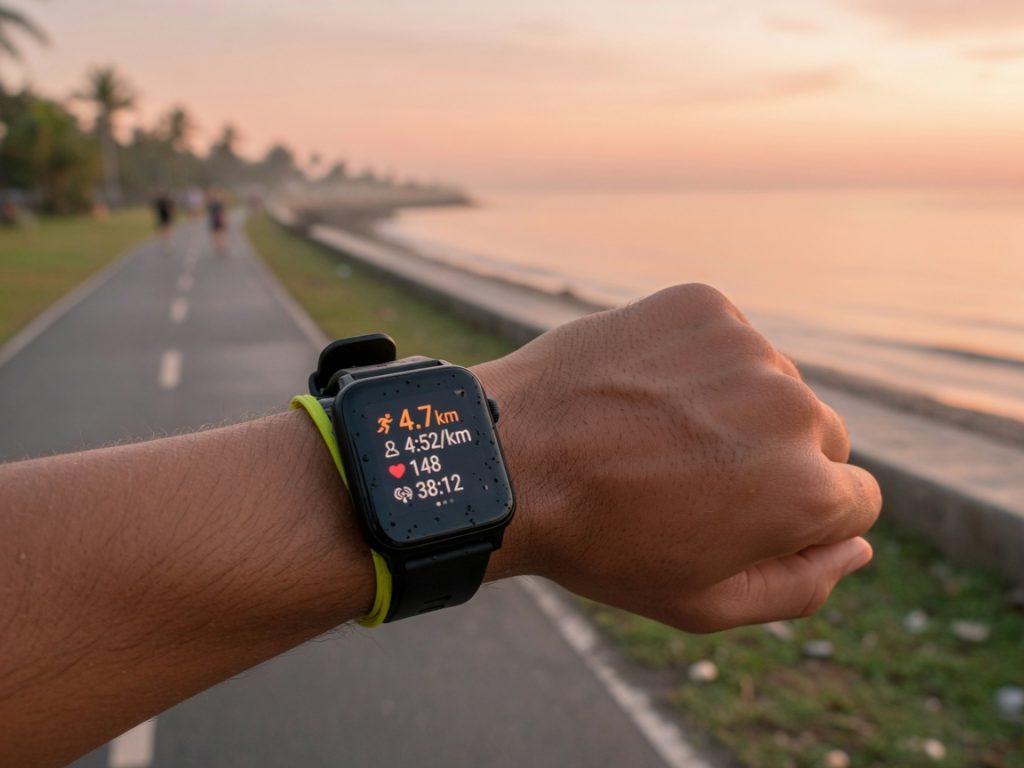
If there’s one training idea that took over running in 2026, it’s Zone 2. Every coaching podcast talks about it. Every watch face flashes it. Half the people in your Sunday group run are suddenly shuffling at a pace they’d have mocked a year ago, glancing at their wrist and insisting they’re “keeping it easy.” I started doing it myself last winter, and I’m not going to pretend I loved it at first. But I’m also not going back. Here’s an honest, plain-language guide to what Zone 2 actually is, why slow makes you fast, and how a beginner can start without overthinking it.
What Zone 2 actually is
Heart-rate training splits your effort into five zones, numbered 1 through 5. Zone 1 is walking-pace recovery. Zone 5 is the all-out effort you can hold for maybe a minute. Zone 2 is the low end of your aerobic range — roughly 60 to 70 percent of your maximum heart rate. It’s the intensity where you’re running, but barely.
In practical terms, Zone 2 is the pace at which you can hold a full conversation without pausing for breath between sentences. You’re not gasping. You’re not silent. You could explain a movie plot to the person next to you for twenty minutes. That’s the feel of it.
The reason coaches talk about it constantly is that Zone 2 is where your body builds the stuff that matters for every longer race: mitochondrial density, capillary growth, aerobic efficiency, fat oxidation. It’s the foundation. Skip it and you can fake fitness for a 5K. You can’t fake it for a marathon.
Why “slow makes you fast”
This is the part beginners don’t believe, so let me say it plainly: most runners run their easy days too fast, and their hard days too slow, and they end up stuck in a grey middle zone that builds neither speed nor endurance. Zone 2 is the fix.
When you run easy, you train your aerobic system. Your heart gets stronger, your muscles build more mitochondria (the energy factories in your cells), and your body gets better at burning fat for fuel instead of relying on glycogen. That last part matters more than it sounds: glycogen runs out around the 90-minute mark, fat doesn’t. Train fat-burning and you extend the distance you can run before hitting the wall.
When you run hard, you train something different — your lactate threshold, your VO2 max, your top-end speed. Those sessions are short and sharp, and they only work if you’re actually fresh for them. If you ran your easy day hard, you show up to your workout tired, you can’t hit the paces, and you get slower instead of faster. This is why every real training plan has an 80/20 split: about 80% of mileage easy, 20% hard. Zone 2 is the 80%.
I know it feels wrong the first time. You finish a Zone 2 run and think “that wasn’t even a workout.” It was. You just can’t feel the work the way you feel a tempo run. The work shows up three months later, on the day you accidentally run a 5K personal best without trying.
The biggest beginner mistake: running Zone 2 too fast
If there’s one error that ruins Zone 2 for new runners, it’s this: they run it too fast. They head out, start at what feels like a gentle jog, and within five minutes they’re drifting up into Zone 3 because “this still feels easy.” It feels easy because you’re aerobically fit enough to lie to yourself. The watch doesn’t lie.
The classic symptom is the runner who says “I tried Zone 2 and I had to walk up every hill — it’s impossible where I live.” It’s not impossible. You’re just starting above your true Zone 2 because your aerobic base is underdeveloped. That’s the entire point of the training. Walking is fine. Walking is Zone 2 for a lot of beginners on hills.
The second symptom is the runner who runs all their runs at “kinda hard” and wonders why they’re always tired and not improving. That’s the grey zone. It’s the worst place to live as a runner — hard enough to fatigue you, easy enough to not stimulate any adaptation. Zone 2 fixes it by making easy days actually easy, which makes hard days actually hard.
How to find your Zone 2
There are three ways, and I’d use at least two of them to cross-check.
1. Heart rate formula. The classic is 220 minus your age for max HR, then take 60–70% of that. I’m 38, so my estimated max is 182, and my Zone 2 is roughly 109 to 127 bpm. The problem: the 220-minus-age formula is notoriously inaccurate for individuals. It’s a population average. My real max is 192, so my true Zone 2 is closer to 115 to 134 bpm. That 7 bpm difference is enough to put you in the wrong zone for months. Use the formula as a starting point, then refine.
2. The talk test. This is the field test that never lies. Run with a friend. You should be able to speak in full sentences without reaching for air. If you can only get out three or four words at a time, you’re in Zone 3. If you can sing, you’re in Zone 1. Zone 2 is conversational but not singable. Free, accurate, and the one I still fall back on when I don’t trust my watch.
3. Rate of perceived exertion (RPE). On a 1 to 10 scale where 10 is all-out, Zone 2 is around a 3 to 4. It should feel almost disappointingly easy. If you finish and think “I could have run that twice as long,” you probably nailed it.
For most beginners I’d start with the talk test, add a heart-rate strap once you can afford one, and ignore the formula’s exact numbers after the first week. Your body is a better judge than a math equation.
A 4-week Zone 2 starter plan
If you’re a beginner who’s been running 3 to 4 times a week already, here’s a simple four-week ramp. The goal isn’t mileage — it’s time on feet in Zone 2.
Week 1. Three runs of 30 minutes, all Zone 2. One walk-run combo if you can’t hold Zone 2 running the whole time. No hard days. The point is to learn the effort.
Week 2. Three runs of 35–40 minutes in Zone 2, plus one shorter run of 20 minutes where you throw in four 30-second strides at the end. The strides are your “hard” work — short, relaxed, not all-out. Total: about 2 hours.
Week 3. Four Zone 2 runs: 40, 45, 30, and a 60-minute long run. Keep the strides at the end of two of them. Total: about 2 hours 50 minutes.
Week 4. Same structure as week 3, but push the long run to 75 minutes, all Zone 2. By the end of this week you’ll know the effort by feel and the pace will have quietly dropped for the same heart rate. That’s your first proof it’s working.
Don’t race these runs. Don’t check pace. Check heart rate, check breath, and otherwise let it be what it is.
One more thing on the plan: take a down week after week 4. Cut mileage by 30% for five days, keep the effort easy, and let your body absorb the work. The fitness isn’t built during the runs — it’s built during the recovery from the runs. New runners ignore this and wonder why they feel flat in week 6. You’re not regressing. You’re adapting. Give it room.
Signs it’s working
Zone 2 rewards patience, and the gains are quiet. Here’s what to look for over 6 to 12 weeks:
- Your pace at the same heart rate drops. The run that used to be 10:30 pace at 130 bpm is now 10:00 at 130 bpm. Your aerobic engine is doing more work for less effort. This is the single best signal.
- Your resting heart rate trends down. Not day-to-day, but week-to-week. A drop of 3–5 bpm over a month is a meaningful sign your cardiovascular fitness is improving.
- Hard days feel harder in a good way. You can hit paces in workouts you couldn’t touch before. The aerobic base is letting you do real work on the days that matter.
- Your recovery between runs improves. The long run doesn’t wreck your Monday. The workout doesn’t wreck your Wednesday. That’s the durability Zone 2 builds.
Signs you’re doing it wrong
The flip side, because I see this in every runner who tries Zone 2 and bails:
- Every run is the same pace. If you’re running your hard days and your easy days at the same speed, you’re not doing Zone 2 — you’re doing the grey zone twice. Easy days must be visibly slower than hard days.
- You’re chronically fatigued. Zone 2 should leave you refreshed, not drained. If you’re tired all the time, either your easy days aren’t easy enough or you’re not recovering enough between runs.
- You defend your pace. If you find yourself explaining to people why you’re running “so slow,” you’re doing it right. If you keep sneaking back up to a respectable pace because it feels embarrassing, you’re doing it wrong. Pride is the main reason Zone 2 fails.
- Your race times aren’t moving after 3+ months. If you’ve been consistent and your races are flat, either your Zone 2 is actually Zone 3, your hard days aren’t hard enough, or you’re racing too often. Usually it’s the first one.
- You’re always running alone because you can’t keep up with the group. This is a positive sign disguised as a negative one — it means you’ve actually slowed down enough to do real Zone 2 work. Run alone, run with slower friends, or run with a podcast. The group run at “conversational pace” is almost always Zone 3.
The honest summary
Zone 2 isn’t magic. It’s not new — coaches have been prescribing low-intensity base work for decades. What’s new in 2026 is that watches finally make it easy to track, and the coaches who’ve been shouting about it finally have an audience willing to listen. The reason it’s a trend is that it works, and it works because it’s the training most recreational runners were skipping.
If you take one thing from this, take this: slow down on your easy days, and your hard days will get faster. That’s the whole idea. The first month feels silly. The second month feels too easy. The third month you PR without trying. I fought it for a year before I committed. Don’t be me. Just try it for four weeks, trust the talk test, and let the pace take care of itself.