Couch to 5K is a nine-week plan that takes you from “I haven’t run since school” to running 30 minutes nonstop, three workouts a week. No speedwork, no gym — just a structured run-walk progression that’s quietly turned millions of non-runners into runners since the BBC launched the program back in 2009.
If you’re sedentary, overweight, coming back from a layoff, or convinced you’re “not a runner,” this is the plan built for you. This guide covers the method, the full week-by-week schedule, how to survive weeks 1–3, how to push through the week-5 wall, the gear you actually need, and how to finish the thing instead of quitting in week 4 like most people do.
Disclosure: Some links are affiliate links. As a partner of the brands mentioned, I may earn a commission from qualifying purchases at no extra cost to you.
The C25K method: run-walk-run
The trick is intervals. Every C25K workout is a mix of jogging and walking, with the jogging chunks getting longer and the walking breaks getting shorter each week. By week 9 you’ve glued them all together into one 30-minute run.
This isn’t a hack — it’s the Jeff Galloway run-walk-run method that’s been around since the 1970s, just structured for beginners. It works for three reasons:
- Walking breaks keep your heart rate below panic, so you don’t end the workout wrecked.
- Short running chunks are easier on joints, tendons, and bones than grinding through 20 minutes of bad form.
- The progress is measurable every week — you can literally see the walk breaks shrinking.
The boring part — going slower than you think you should — is the part that makes the plan actually work.
The full 9-week schedule
Three workouts per week, with at least one rest day between them (Mon/Wed/Fri or Tue/Thu/Sat is the classic pattern). Always start with a 5-minute brisk walk to warm up and end with a 5-minute walk to cool down — those are in every single workout, non-negotiable.
| Week | Workout pattern (between the two 5-min walks) | Session time |
|---|---|---|
| 1 | 60 sec jog / 90 sec walk — repeat × 8 | ~20 min |
| 2 | 90 sec jog / 2 min walk — repeat × 6 | ~20 min |
| 3 | 90 sec jog / 90 sec walk × 2, then 3 min jog / 3 min walk × 2 | ~20 min |
| 4 | 3 min jog / 90 sec walk × 2, then 5 min jog / 2 min walk, then 3 min jog / 90 sec walk | ~25 min |
| 5 | D1: 5 jog / 3 walk × 2, then 5 jog. D2: 8 jog / 5 walk, then 8 jog. D3: 20 min continuous jog. | ~25–30 min |
| 6 | D1: 5 jog / 3 walk, 8 jog / 3 walk, 5 jog. D2: 10 jog / 3 walk, 10 jog. D3: 22 min continuous. | ~25–30 min |
| 7 | 25 min continuous jog × 3 | ~30 min |
| 8 | 28 min continuous jog × 3 | ~35 min |
| 9 | 30 min continuous jog × 3 | ~35 min |
That’s the entire program. Print it, screenshot it, tape it to the fridge.
Weeks 1–3: surviving the first runs
The first three weeks are about one thing: showing up. Pace doesn’t matter. Distance doesn’t matter. Form is irrelevant. The only job is to do three workouts a week for three weeks and let your body figure out that running is a thing you do now.
Pacing: slower than you think
If your first 60-second jog feels easy, you’re going too fast. Your “jog” should feel almost embarrassingly slow — a shuffle you could hold a conversation through. Most beginners sprint the first interval, die by the third, and decide running isn’t for them. The fix is one notch slower than feels honest.
I’ve been the person who couldn’t run for five minutes. The trick wasn’t toughness, it was going slower than I thought counted as running — and it’s the same thing that got me back into training after a type 2 diabetes diagnosis and 20kg of weight gain. If you’re coming back from a medical thing or a long layoff, the full story of that comeback is here.
Breathing
Breathe however keeps you relaxed — don’t overthink it. The simpler rule: if you can’t speak a full sentence out loud, slow down. That’s your heart-rate alarm.
The 20–30 minute habit
Each session is around 20–30 minutes including warm-up. That’s short enough that you can’t really talk yourself out of it. Don’t extend it. Don’t add a fourth workout. Boring works.
Weeks 4–6: the mental wall
Week 5 is where half of C25K attempts die. The plan jumps from “lots of walk breaks” to a 20-minute continuous run on week 5 day 3, and on paper it looks impossible. It isn’t — but it’s the first time you have to trust the plan instead of your feelings.
A few things that helped me and everyone I’ve coached through it:
- Slow down again. You earned some fitness in weeks 1–4, your instinct is to speed up. Resist. Week 5 is the time to run your slowest yet.
- Don’t test yourself. No “let me see if I can do day 3 today.” Do the days in order, with the rest days between them.
- Consistency beat intensity every single time. The same rule that got me back into training after my diabetes diagnosis applies here — showing up three times a week beats one heroic session.
If week 5 day 3 doesn’t click the first time, repeat the week. There’s no penalty. The plan is a nine-week target, not a contract.
Weeks 7–9: building to 30 minutes straight
The back third of the plan is the most satisfying. The intervals are gone. You’re just running — 25, then 28, then 30 minutes — three times a week, and each week feels noticeably easier than the last because your aerobic base is finally real.
Two things to watch:
- Keep the easy pace. 30 minutes at a slow jog gets you to around 4–5 km for most beginners. Trying to hit a full 5K in 25 minutes is how you blow up in week 8.
- If something hurts, stop. Cardio tiredness is fine; sharp pain in a knee, shin, or Achilles is not. Take two extra rest days and pick up where you left off.
By the end of week 9 you’ll run 30 minutes nonstop — between 4 and 5 km for most people, close enough to “5K” to count. The distance doesn’t matter; the habit does.
What gear you actually need
The minimalist version:
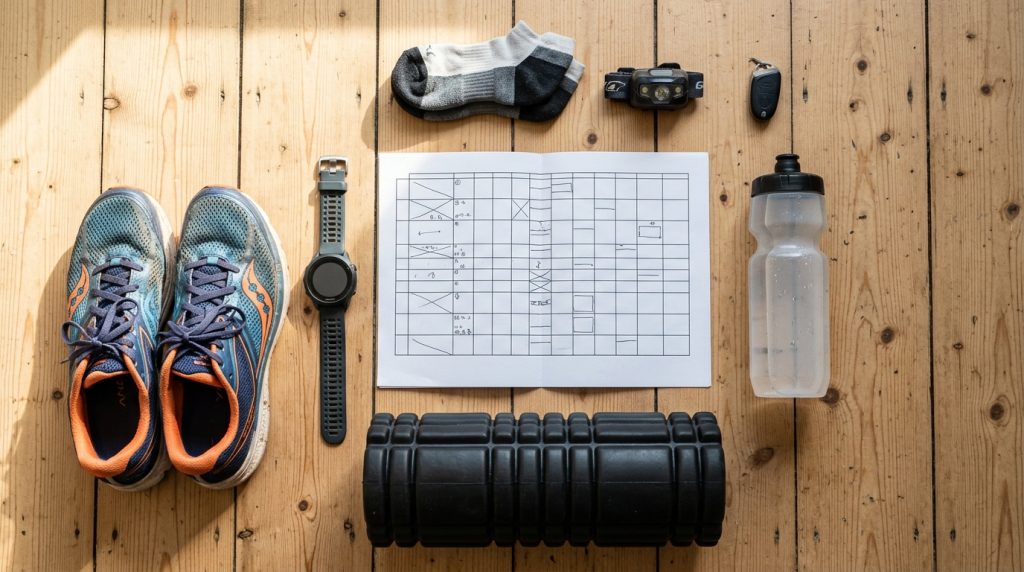
- One pair of real running shoes. Not fashion sneakers, not the worn-out pair from the back of the wardrobe. A proper entry-level trainer from a real running brand is the single investment that matters — it’s what keeps your knees and shins happy as the mileage builds. For the full brand-by-brand roundup see our best running shoes 2026 guide; entry-level picks like the Brooks Adrenaline, Asics Gel-Excite, or On Cloud are all solid C25K options.
- A watch or phone app to track the intervals. Week 1 you need to know when 60 seconds is up. The free NHS C25K app, Runkeeper, or any generic interval timer handles it. If you want a watch that carries you past C25K into 10K and half-marathon territory, the best running watches for beginners rounds up what’s actually worth it.
- Comfortable clothes you already own. That’s it. Don’t buy a wardrobe.
Optional, but worth it once you’re sure you’ll keep going: a GPS watch. The Garmin Forerunner 165 is the sweet spot right now — accurate GPS, decent battery, no overkill features — and the Apple Watch SE does the same job on iPhone. Both are covered in our best GPS running watches 2026 pillar.
One thing you don’t need: energy gels. C25K workouts top out at 30 minutes. You don’t need fuel for that — water on hot days, maybe. Anyone trying to sell you Maurten or GU for week 4 is upselling you.
Common mistakes that get beginners injured
- Too fast, too soon. The number-one cause of shin splints, runner’s knee, and the C25K dropout rate. If your lungs are burning in week 2, you’re running your future 5K pace, not your C25K pace. Slow down.
- Skipping the warm-up walk. That 5-minute brisk walk primes your calves and Achilles. Skip it and the first three minutes of running feel like concrete.
- Wrong shoes. Cheap flat sneakers will hurt you by week 4. If your foot rolls inward (overpronation — like mine does), a neutral shoe will make your knees angry within a fortnight. Here’s a quick self-check for overpronation and the stability shoes that fix it.
- Running on sore legs. Muscle soreness 1–2 days after a workout is normal. Running through sharp pain is how a one-week niggle becomes a six-week injury.
- Adding a fourth workout “to catch up.” Don’t. Three is the program. More breaks people.
After C25K: what’s next
Three things to do in the first month after you finish:
- Run an actual organized 5K. Parkrun (free, Saturday morning, worldwide) is the obvious one. A real event with other people is a different experience from a solo training run, and finishing one turns “I’m doing C25K” into “I’m a runner.”
- Hold the 30-minute habit for two weeks. Don’t immediately chase 10K. Run 30 minutes three times a week for a fortnight and let the fitness settle.
- Then pick a next goal. Most people go one of two ways: a faster 5K, or a longer race. The longer path eventually points at a marathon — and if that sounds absurd right now, it shouldn’t. Everyone you’ll line up next to at a marathon start was once in week 4 of C25K. Our 16-week marathon training plan is the bridge.
Frequently asked questions
Can I repeat a week if I’m not ready?
Yes — repeat any week as many times as you need. The plan is a nine-week target, not a deadline. Most people repeat week 5 or week 6 at least once. If you need twelve weeks, take twelve.
Is a treadmill OK for C25K?
Completely. Set the incline to 1% to mimic outdoor effort, and don’t hold the handrails. Treadmill C25K is a legitimate option for bad weather, bad air quality, or bad neighborhoods. Same plan, same progression.
I’m overweight — can I still do C25K?
Yes, and run-walk-run is genuinely the safest way in. The intervals protect your joints while they adapt to impact. I started my comeback 20kg heavier than I am now; the plan works at any starting weight, you just go slower than you think. The full story of that comeback is here.
I’m over 50 — is it too late to start running?
No. C25K works at any age. The only adjustments: warm up properly, don’t skip strength work (twice a week, even bodyweight is fine), and listen to your joints more than your lungs. Most of your peers on race day will be in your age group.
I have asthma or diabetes — can I do C25K?
Yes, with one caveat: get medical clearance first, especially if you’re newly diagnosed or changing medication. Running is one of the best things you can do for both conditions, but the fueling and medication timing genuinely matter. I wrote about coming back to training with type 2 diabetes here — same principles apply to C25K.
The bottom line
Couch to 5K is the single best entry point to running that exists, and the reason is stupid simple: it asks you to do less than you think you should, three times a week, for nine weeks. Most people fail C25K because they ignore the slow bits.
Three workouts a week. Slower than you think. Nine weeks. That’s the whole thing.
For gear, start with one real pair of shoes from our best running shoes guide and let the rest wait until week 5 — by then you’ll know you’re going to finish.